
What Is an Arc Flash Risk Assessment?
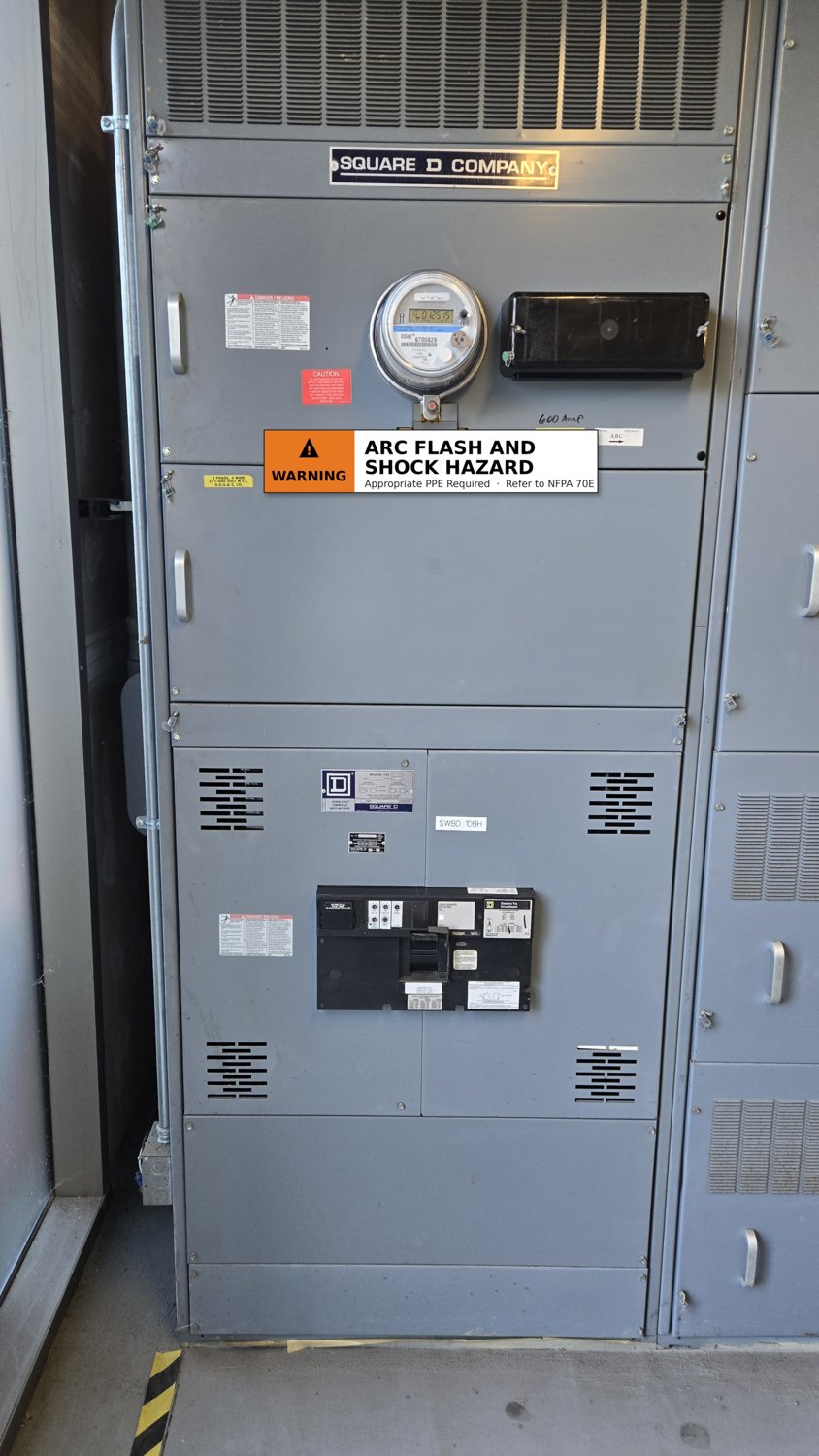
An arc flash risk assessment is an engineering analysis of your facility's electrical distribution system. It calculates the incident energy available at each piece of equipment — panels, switchboards, motor control centers, transformers — so you know the arc flash hazard at every location and can select the right personal protective equipment (PPE).
You may also hear it called an arc flash study. It's the same work — "arc flash risk assessment" is the term NFPA 70E uses, and it's the term your safety program documentation should use.
Why Your Facility Needs One
- OSHA requires employers to protect workers from recognized electrical hazards, including arc flash.
- NFPA 70E requires an arc flash risk assessment to establish safe work practices and PPE requirements. Assessments must be reviewed at least every five years, or whenever significant changes are made to the system.
- Due diligence — a documented assessment supports your safety program in audits, insurance reviews, and incident investigations.
- Worker safety — the assessment gives your electricians and contractors the information they need to work safely: approach boundaries, PPE categories, and clearly labeled equipment.
If your facility has never had an assessment performed, or if your last one is more than five years old, it is time for a review.
What the Requirements Say
NFPA 70E — Article 130.5
An arc flash risk assessment shall be performed before work is done on or near energized equipment. The assessment must be updated when a major modification or renovation takes place, and reviewed at intervals not to exceed five years. Equipment must be labeled with the incident energy, the arc flash boundary, and the required PPE.
NFPA 70B — the 2023 edition
NFPA 70B changed from a recommended practice to a standard, and its language changed from "should" to "shall." Facilities are required to develop and implement a documented Electrical Maintenance Program (EMP). Chapter 9 (Table 9.2.2) sets mandatory maintenance scopes and intervals for each type of equipment, based on a condition assessment — the equipment's physical condition, its criticality, and its operating environment. The program includes recurring infrared thermographic inspection of electrical equipment. This matters to your risk assessment because NFPA 70E's analysis assumes equipment is properly maintained; breakers that aren't maintained to NFPA 70B may not clear a fault in the time your labels promise.
OSHA
Federal OSHA law reaches arc flash from several directions:
- General Duty Clause — Section 5(a)(1) of the OSH Act. Employers must provide a workplace free from recognized hazards. Arc flash is a recognized hazard, and OSHA uses NFPA 70E as evidence of what a reasonable employer does about it.
- 29 CFR 1910.132(d). The employer shall assess the workplace to determine what hazards require PPE, select the PPE for each affected employee, and certify the assessment in writing. An arc flash risk assessment performed per NFPA 70E is how you satisfy this for electrical work — OSHA has stated that employers who conduct the assessment and PPE selection per NFPA 70E are deemed in compliance with this standard.
- 29 CFR 1910.333(a). Live parts must be deenergized before an employee works on or near them, unless deenergizing is infeasible or creates additional or increased hazards.
- 29 CFR 1910.335. Employees working where potential electrical hazards exist must be provided with and use protective equipment, and hazards must be marked with signs, tags, and labels.
What's Included
- Field data collection — our technicians visit your facility and document every relevant component: transformers, switchgear, panelboards, circuit breakers, fuses, conductor sizes and lengths, and available utility data.
- Engineering analysis — we build a model of your electrical system, perform short-circuit and coordination calculations, and compute incident energy and arc flash boundaries per IEEE 1584.
- Equipment labels — we provide NFPA 70E-compliant arc flash warning labels for each analyzed location, showing incident energy, working distance, and required PPE.
- Report — you receive a complete report with analysis results, one-line diagrams, device settings, and practical recommendations your team can act on.
Pairs with: Coordination Studies · Infrared Scanning · Breaker Testing
Schedule a Free Consultation
Not sure whether your facility is compliant, or working against a deadline? We'll review your situation and give you a straight answer.