
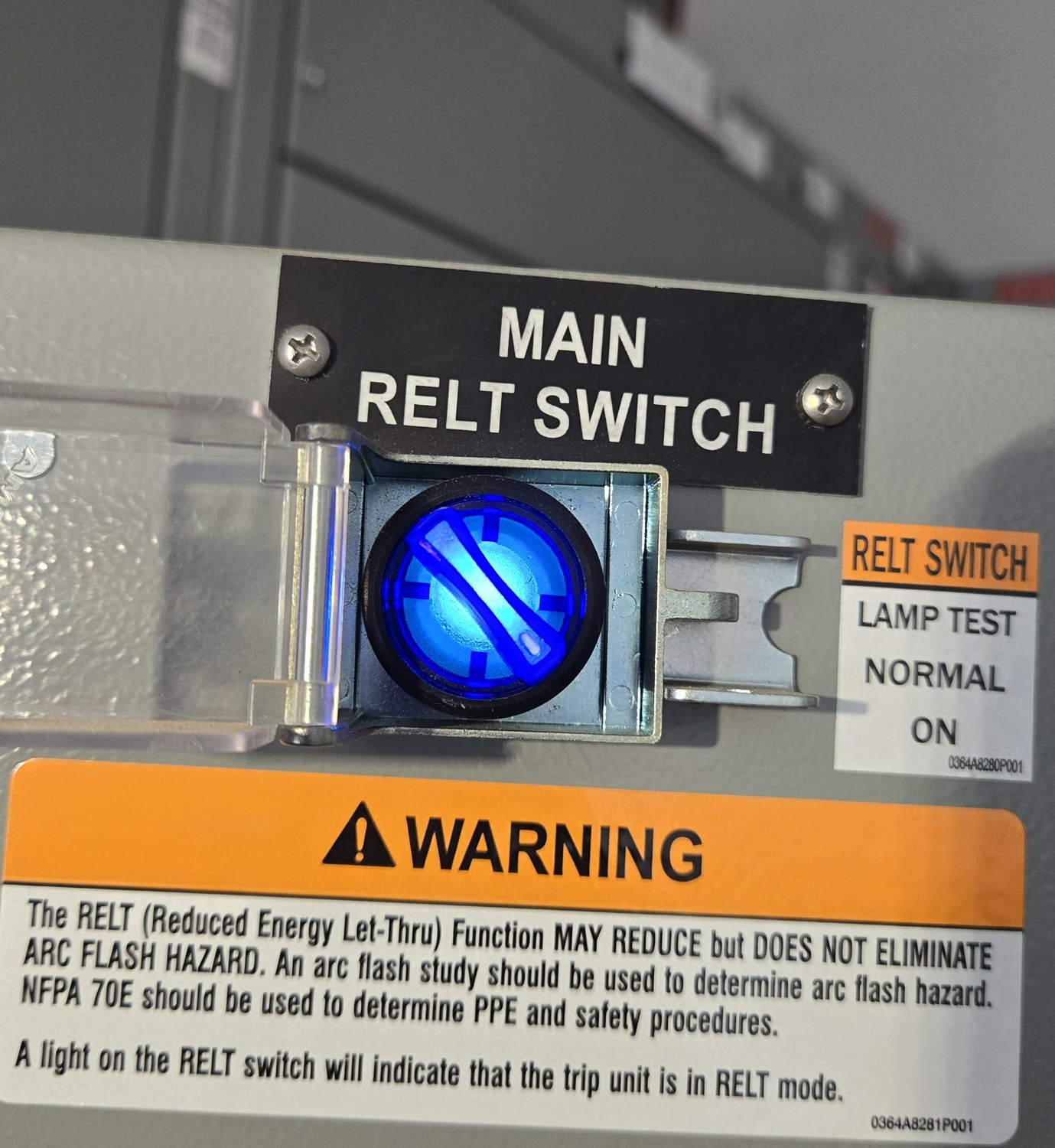
Arc Energy Reduction Is an NEC Requirement
NEC 240.87 requires that wherever a circuit breaker's highest continuous current trip setting is rated — or can be adjusted — to 1,200 amps or higher, the installation must include a method to reduce the breaker's clearing time, and documentation of those breaker locations must be available to the people who design, install, operate, or inspect the installation.
The NEC allows several methods: zone-selective interlocking, differential relaying, an energy-reducing active arc flash mitigation system, an instantaneous trip setting or override below the available arcing current, or an approved equivalent. The method most facilities actually have is energy-reducing maintenance switching with a local status indicator — sold under different names depending on the manufacturer:
- RELT (Reduced Energy Let-Through) — ABB / GE
- ARMS (Arcflash Reduction Maintenance System) — Eaton
- ERMS (Energy Reduction Maintenance Setting) — Schneider Electric
- Maintenance mode / maintenance switch — generic field term
A companion rule, NEC 240.67, applies the same idea to large fused devices.
How a Maintenance Switch Protects Your People
Incident energy is mostly a function of time: the longer an arcing fault burns, the more energy is released. Under normal settings, a large breaker may intentionally delay tripping for coordination — exactly the wrong behavior when a worker is inside the arc flash boundary.
With a maintenance switch, the worker turns the switch before starting work. The trip unit shifts to an alternate instantaneous setting with no intentional delay, so a fault clears in a fraction of the normal time and the available incident energy drops dramatically — often enough to lower the required PPE. A local status indicator shows the reduced mode is active. When the work is done, the switch returns the breaker to its normal, coordinated settings.
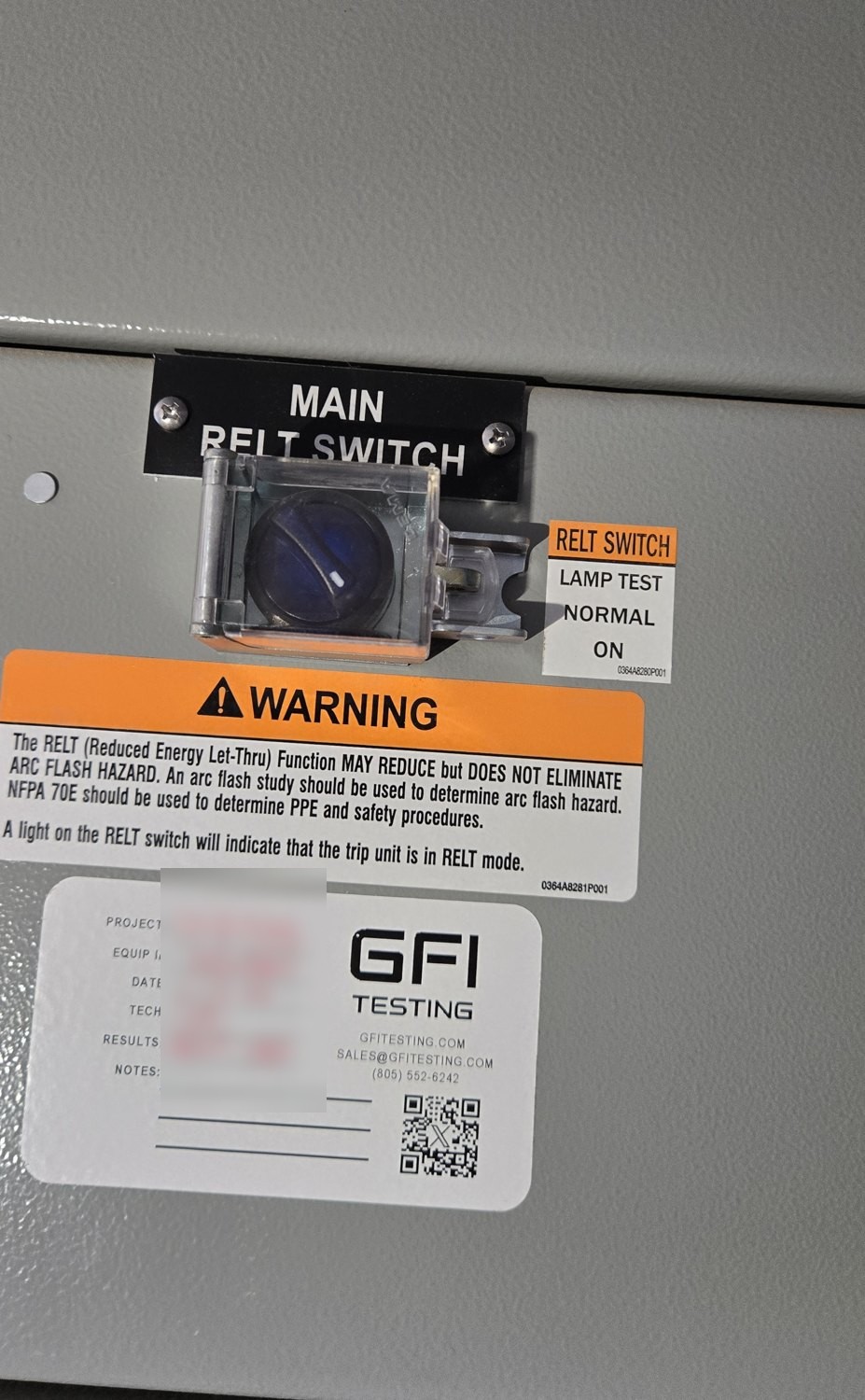
If It Has Never Been Tested, You Don't Know It Works
A maintenance switch is a chain of parts — switch, wiring, trip-unit input, alternate settings group, status indicator — and any link can fail silently. We routinely find switches that were never wired, indicators that light while the settings never change, and reduced settings that don't match the arc flash risk assessment. The NEC requires the method to be provided; testing is how you prove it functions.
What We Test
- Activation — engage the reduced-energy mode from the switch and confirm the trip unit actually changes settings groups, not just the indicator light.
- Status indication — verify the local status indicator required by NEC 240.87 shows the mode correctly.
- Trip testing in both modes — secondary or primary injection testing in normal and reduced modes to verify pickup values and clearing operation.
- Settings verification — confirm as-found and as-left settings in both modes against your coordination study and arc flash risk assessment.
- Return to normal — confirm the breaker restores full normal settings when the switch is turned off.
- Report — a written test report documenting both modes, which supports the documentation NEC 240.87 requires you to have available.
Schedule a Free Consultation
Have a 1,200-amp or larger breaker on your service? We'll confirm whether you have an arc energy reduction method installed and test it so you know it works.